Table of Contents
India and the UAE have built one of the most active trade corridors in the world and the numbers keep getting bigger. In 2025–26, bilateral trade between the two countries crossed $101.25 billion for the second consecutive year, cementing what was once an ambition into a consistent reality. India’s exports to the UAE alone touched $37.36 billion during this period, with growth recorded across gems and jewellery, engineering goods, electronics, and agriculture.
For Indian businesses, whether you’re a manufacturer, a trader, or an entrepreneur just exploring options, Dubai remains the most strategic entry point into this market. It’s not just a city; it’s a distribution hub that connects Asia, Africa, the GCC, and parts of Europe through a single gateway.
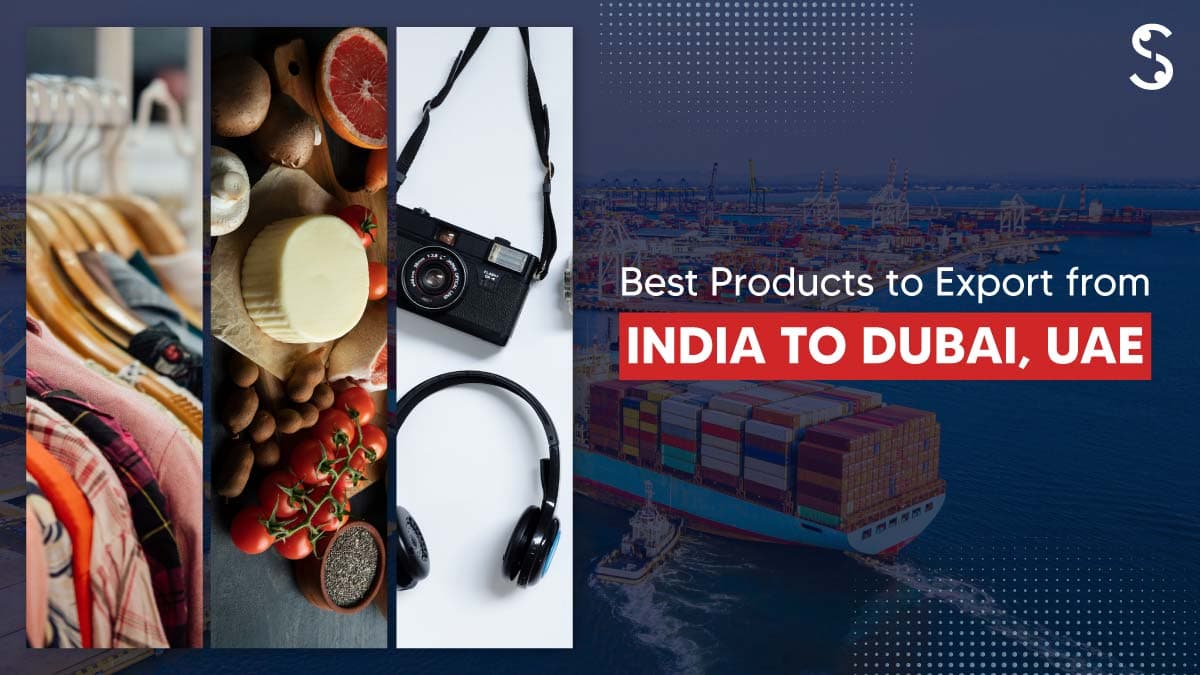
This guide covers the best products to export from India to Dubai right now, why this trade corridor is more accessible than ever, and what you need to know before getting started.
Before diving into the product categories, it helps to understand what makes Dubai such a compelling destination for Indian exporters specifically.
Here’s a detailed look at the top categories on the Dubai import from India list – what sells, why it sells, and what you need to know about each.

This is India’s single largest export category to the UAE. India cuts and polishes approximately 90% of the world’s diamonds, and Dubai’s status as a global gold trading hub makes it the natural destination. Gems and jewellery exports from India reached $30.47 billion globally in FY 2024–25, with the UAE and US as the two dominant markets.
Under CEPA, customs duties on jewellery were eliminated almost entirely, and the impact has been immediate, exports in this category jumped from around $4.9 billion to $8 billion between the agreement’s implementation and FY 2024. Gold jewellery, cut diamonds, gemstones, and silver articles all perform strongly. Buyers in Dubai’s Gold Souk and global wholesale networks operating out of the UAE are consistent, repeat customers for quality Indian suppliers.
What to note: Hallmarking, BIS certification, and Kimberley Process compliance (for diamonds) are essential for export. Secure air freight and comprehensive insurance coverage are standard in this category.
Textiles are one of the most consistent entries on any India to Dubai export items list, and for good reason. India exported approximately $36 billion worth of textiles and apparel globally in FY 2024–25, with the UAE among the top five destinations. Cotton fabrics, ready-made garments, silk, home textiles, and synthetic fabrics all find strong buyers in Dubai’s retail and wholesale markets.
Ethnic wear like sarees, lehengas, anarkalis, kurta sets, and Indo-western fusion styles occupies a special position. The UAE’s large South Asian population, combined with the high frequency of weddings, festivals, and cultural events in the city, creates year-round demand. Dubai-based buyers also re-export ethnic wear into Africa and Central Asia.
What to note: CEPA immediately eliminated tariffs on 80% of labour-intensive textile products. This makes Indian garments significantly more price-competitive compared to Chinese and Bangladeshi alternatives in the UAE market.
Dubai imports the vast majority of its food. India, with its agricultural diversity, large-scale production, and long coastline, is a natural supplier across almost every food subcategory.
Basmati rice is the flagship product, but the list of Dubai imports from India in this category goes much further: wheat flour, lentils, sugar, tea, coffee, onions, mangoes, fresh vegetables, dairy products, and processed foods all move in significant volumes. Packaged ready-to-eat meals, masalas, pickles, chips, namkeen, and frozen parathas ship extremely well, particularly to Indian grocery stores and supermarket chains with a large South Asian customer base.
Spices deserve special mention. Indian cardamom, turmeric, cumin, coriander, chilli, and blended masala products dominate Dubai’s spice souks. The demand is consistent and driven by both household consumption and the city’s booming restaurant and catering industry.
What to note: Food exports require FSSAI compliance on the Indian side and UAE food safety approvals and labelling requirements on arrival. Halal certification is mandatory for meat and poultry products.
India is the world’s pharmacy, supplying over 20% of global generic medicines by volume and 40% of generic drugs consumed in the UAE. Indian pharmaceutical exports globally reached a record $30.47 billion in FY 2024–25, and the UAE is a key destination for generic medicines, OTC products, Ayurvedic formulations, wellness supplements, surgical instruments, and diagnostic equipment.
CEPA has simplified pharmaceutical trade considerably, with streamlined customs procedures and better regulatory alignment. Importantly, Dubai serves as a healthcare hub for the broader GCC and parts of Africa — meaning Indian pharma products sold into the UAE frequently move on to hospitals and pharmacies across the region, creating scalable repeat order cycles rather than one-off transactions.
What to note: Product registration with the UAE Ministry of Health and Dubai Health Authority is required before market entry. This can take time but, once cleared, tends to generate long-term consistent orders.
Engineering goods account for approximately 26.67% of India’s total export basket, the largest single share of any category, and the UAE is consistently among the top five destinations. Products in this category include industrial machinery, pumps, valves, auto components, electrical equipment, structural steel, and construction-related hardware.
Dubai’s ongoing infrastructure development, Expo City expansion, renewable energy projects, and logistics hub construction create sustained demand for Indian engineering products. Automobile parts such as engine components, tyres, batteries, and electrical systems are particularly active, as Dubai serves as a regional distribution centre for auto parts across the GCC. Indian engineering goods are valued for combining reasonable quality with significantly lower price points than European or Japanese alternatives.
What to note: UAE’s infrastructure ambitions show no sign of slowing. Engineering goods exporters who establish relationships with Jafza-based distributors or direct project contractors can build long-term supply contracts.
Electronics is now India’s fastest-growing export category. Mobile phone exports alone went from ₹1,500 crore in 2014–15 to ₹2 lakh crore in 2024–25, a 127-fold increase in a decade, driven primarily by the Production-Linked Incentive (PLI) scheme and the arrival of Apple, Samsung, and Foxconn manufacturing in India. Smartphones from Indian factories generated $2.57 billion in exports to the UAE in FY 2023–24.
Beyond phones, consumer electronics, solar components, and other tech products are gaining ground in the UAE’s retail and re-export channels. The bilateral trade data officially confirmed electronics as one of the four fastest-growing sectors under CEPA, alongside gems, engineering goods, and agriculture.
What to note: UAE’s ESMA standards apply to consumer electronics. UPI–AANI payment interlinking (activated October 2024) has reduced transaction friction for Indian electronics SMEs selling into UAE retail channels.
India’s extensive coastline, combined with a growing aquaculture industry, makes it one of the world’s top seafood exporters. Fish, crustaceans, molluscs, and processed seafood are significant components of the UAE import products list from India, with exports valued at around $157 million annually to the UAE. Frozen and processed varieties, particularly shrimp and fish fillets, are in consistent demand for both domestic UAE consumption and regional re-export.
India exports substantial volumes of halal-certified frozen buffalo meat and related animal products to the UAE, driven by the country’s large Muslim population and well-established halal supply chain. This category has consistently ranked among the top export segments by volume in recent trade data. Major Indian exporters in this space, including Allanasons and Fair Exports India, have long-standing relationships with UAE importers.
Organic and inorganic chemicals, speciality chemicals, plastics, and agricultural fertilisers form a sizeable part of the most exported products from India to Dubai. These materials support the UAE’s industrial manufacturing, infrastructure, and growing sustainability and urban agriculture initiatives. India’s cost-competitive chemical production, backed by companies like Aarti Industries, Tata Chemicals, and Deepak Nitrite, makes it a preferred supplier for UAE industrial buyers. The chemical sector globally reached $12–15 billion in Indian exports in FY 2024–25.
Dubai’s thriving tourism, hospitality, and luxury retail sectors create a natural market for Indian handcrafted goods. Wooden furniture, brassware, pottery, hand-woven textiles, decorative items, and artisanal pieces are sourced by Dubai’s hotel and resort interior contractors, retail gift stores, and international trade buyers looking for distinctive, high-quality products at competitive prices. Handicrafts exports from India reached $3.89 billion globally in FY 2024–25, with Middle Eastern markets (particularly the UAE) among the key destinations.
The India–UAE CEPA is worth understanding in more detail, because it’s actively reshaping which products are now viable to export and at what margins.
If you’re ready to move beyond research and into action, here’s a practical summary of what the process involves:
Issued by the Directorate General of Foreign Trade (DGFT), this is mandatory for all Indian exporters. The process is online and relatively straightforward.
Harmonised System codes classify your product and determine the applicable duty rates in both India and the UAE. Getting this right is essential for claiming CEPA tariff benefits.
Federation of Indian Export Organisations registration adds credibility and gives you access to government export support schemes, trade fair subsidies, and market access initiatives.
Standard export docs include a commercial invoice, packing list, bill of lading or airway bill, and a Certificate of Origin (CoO). The CoO is specifically required to claim CEPA benefits at UAE customs. Product-specific certificates (phytosanitary, halal, FSSAI, etc.) are additional requirements depending on your category.
Products entering Dubai must meet Dubai Municipality and ESMA (Emirates Authority for Standardisation and Metrology) requirements. Non-compliance leads to shipment holds and returns, which are costly.
Most Indian goods enter Dubai via Jebel Ali Port (sea freight) or Dubai International Airport (air freight). Work with a reliable freight forwarder who knows both the Indian export process and UAE customs clearance.
Key trading areas in Dubai include Deira (food, textiles, gold), Al Quoz Industrial Area (machinery, building materials), and Jebel Ali Free Zone (manufacturing, re-export businesses). Many Indian exporters build their first relationships through UAE trade fairs and the FIEO’s market access programmes.
Many experienced Indian exporters take a step beyond shipping goods: they set up a UAE-registered entity to handle local distribution, client relationships, and re-exports. It’s a move that increasingly makes commercial sense.
A UAE trade licence makes you a local business partner to Dubai buyers, which simplifies contracts, speeds up payments, and builds the kind of trust that repeat orders depend on. Free zone entities in Jebel Ali Free Zone (Jafza), DMCC, or DWTC offer full foreign ownership, zero import duties, and 100% profit repatriation. Jafza alone welcomed 283 new Indian companies in 2024, a 15% year-on-year increase, which gives you a sense of how quickly this trend is growing.
If you’re thinking about this route (whether that’s a free zone company, a mainland entity, or understanding which licence type fits your export model) Shuraa India can walk you through the process. We help Indian businesses through company formation in Dubai, from choosing the right structure to completing the setup and staying compliant.

About the author
Kajol KanojiaKajol is a skilled writer and UAE corporate advisor with deep expertise in business consulting. She specializes in guiding entrepreneurs, simplifying UAE business setup, and navigating local regulations, market trends, and cultural nuances. Through her insightful blogs and practical advice, Kajol helps Indian and global entrepreneurs establish and grow their businesses in the UAE efficiently and successfully.
View all postsGet clear support on licensing, jurisdictions, visas, banking, and setup costs, all from one expert team.